Birth Control
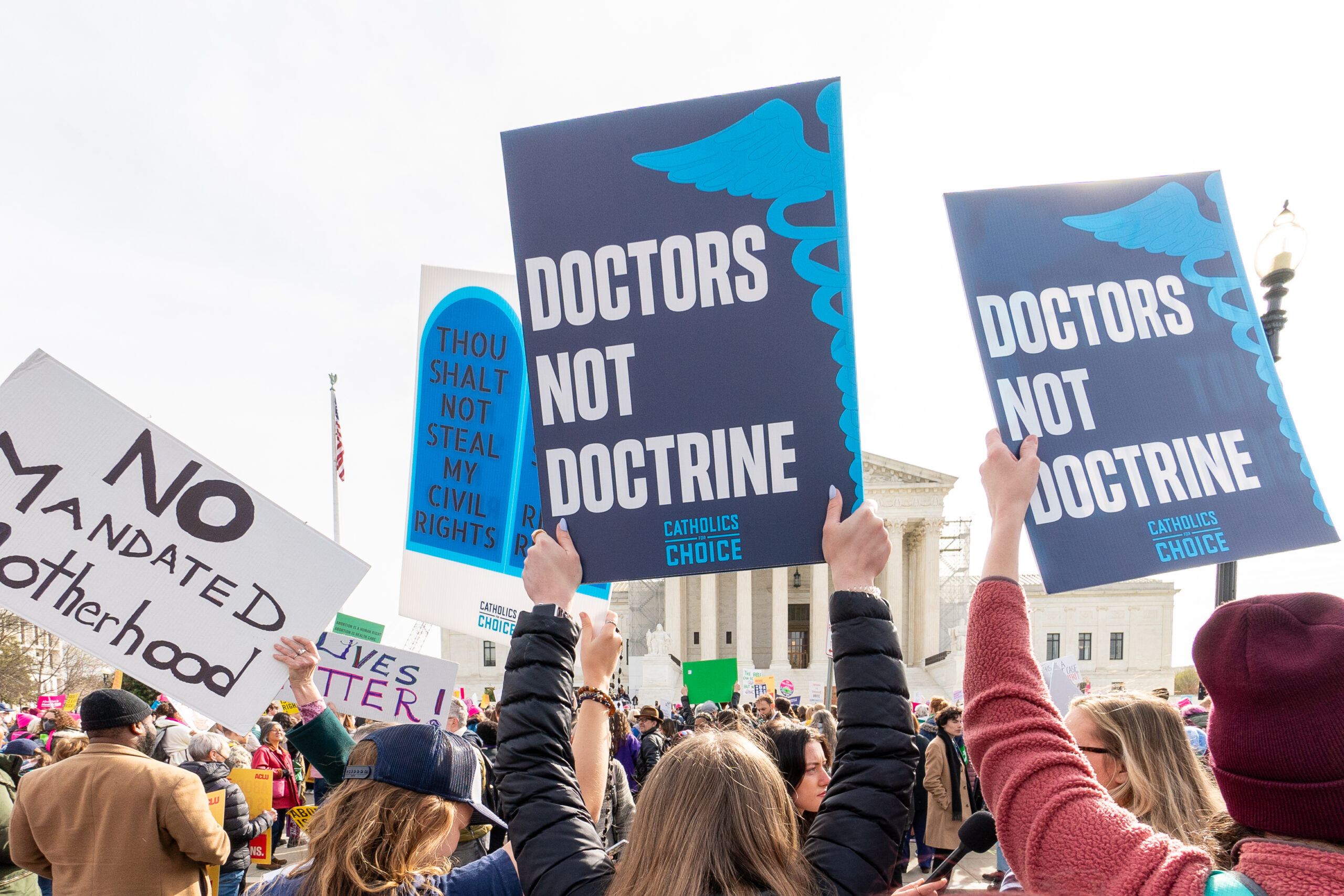
The Catholic church hierarchy opposes all forms of artificial contraception, yet 98% of Catholics in the United States have used some form of birth control at some point in their lives. Catholics for Choice envisions a world in which everyone has equal access to all forms of birth control, unencumbered by religious persecution. We believe that access to birth control is, in fact, a Catholic social justice value.
For countless people around the world, access to contraception is a matter of life or death. Untold numbers of people are suffering as a direct consequence of Catholic church officials’ ban on birth control. Today, ordinary Catholics are taking a stand against the hierarchy. Birth control is not a sin — it is a lifeline.
Support access to contraception
of Catholics believe birth control is morally acceptable

Support legal abortion access
of Catholics say abortion should be legal in most cases
Use contraception in their lives
of Catholics have relied on birth control at some point

Questions about Catholics and Birth Control
We've compiled these talking points to help inform Catholic conversations about birth control.
The different forms of birth control recognized and approved by the Food and Drug Administration are:
- Barrier methods that include condoms, diaphragms, and sponges
- Hormonal methods, like birth control pills and vaginal rings
- Sterilization procedures, like tubal ligation and vasectomies
- Implanted devices, like intrauterine devices (IUDs)
- Emergency contraception, like Plan B and Ella
Family planning refers to the ability of individuals and families to anticipate and attain their desired number of children and to choose the spacing and timing of their births. It is best achieved through the use of artificial contraceptive methods.
According to the Centers for Disease Control and Prevention, family planning is one of the 10 great public health achievements of the 20th century, on par with such accomplishments as vaccination and advances in motor vehicle safety.
The Catholic church hierarchy forbids all forms of artificial contraception, including condoms, birth control pills, IUDs (intrauterine devices), tubal ligation, vasectomies, and emergency contraception like Plan B.
The Catholic church hierarchy forbids birth control such as condoms or the pill because it views them as separating sexual intercourse from its intended consequence of reproduction. They endorse only “natural family planning” methods to avoid pregnancy because all other methods present a physical barrier to the natural reproductive process.
According to the National Institute of Health, approximately 1% of people in the United States use natural family planning. It has a typical failure rate of 24%.
Despite the Catholic hierarchy’s ban on other methods, 98% of Catholics have used some form of birth control in their lives. Ultimately, your individual conscience is the final arbiter of what is right or wrong.
Church officials and others falsely argue that certain forms of contraception are abortifacients, which would mean that they induce abortions. These include IUDs, Plan B, and Ella (ulipristal acetate).
Overwhelming scientific evidence shows that the IUD, Plan B, and Ella work only as contraceptives and are not abortifacients.
There is only one drug approved to induce abortion called RU-486 (mifepristone).
Institutionally, the Catholic church hierarchy has taken the position that the only morally acceptable way to avoid HIV and AIDS is to abstain from sex outside of marriage and to abstain from sex within marriage if your partner is HIV-positive. Its position is based on the church’s teaching that sex should only take place within marriage and should always be open to procreation.
There are various ways people can prevent the transmission of HIV. For people who are sexually active, using latex condoms correctly and consistently is one of the most effective ways to prevent infection.
Birth Control Insights & Resources
Stay informed with the latest articles, reports, and other resources on birth control.
Just the Facts: Catholic Perspectives on Sex, Gender, and Reproductive Health
Just the Facts: Catholic Perspectives on Sex, Gender, and Reproductive Health provides the latest data about American Catholics’…
Get to Know Us!
Catholics for Choice is a nonprofit organization that encounters, educates, and emboldens people of faith who support reproductive…
¡Conócenos!
Somos una organización que representa y enaltece las voces de la mayoría de las personas católicas que creen…
Pack of Prayer Cards — English
Download this two-pack of pro-choice prayer cards: One for St. Brigid, the patron saint of fertility and children,…
Sign up with just your email
We respect your privacy and will never sell your data.
Support the work of faithful advocacy
Help us challenge and dismantle religiously-based barriers to safe, legal, and comprehensive reproductive healthcare.
Donate